
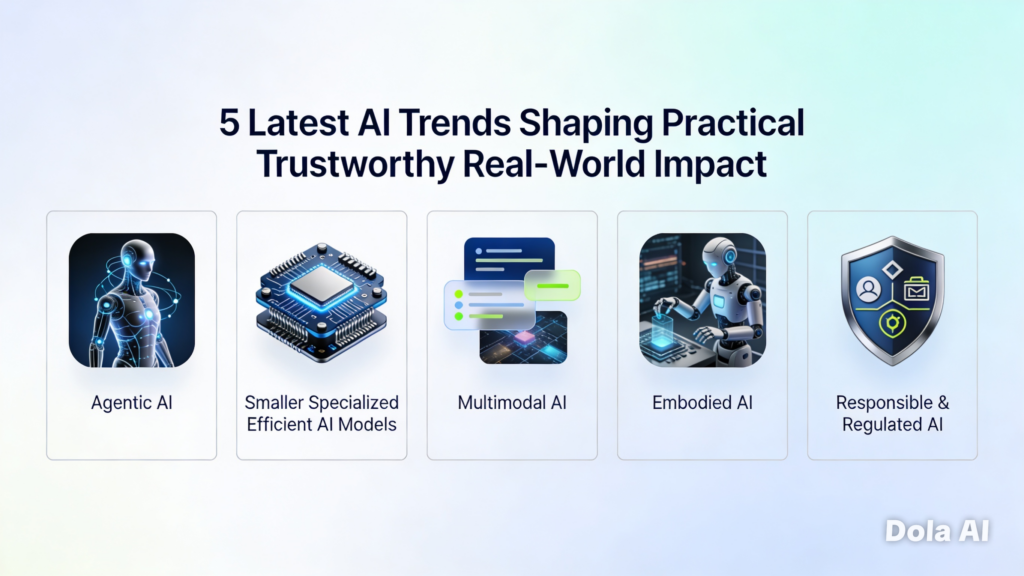
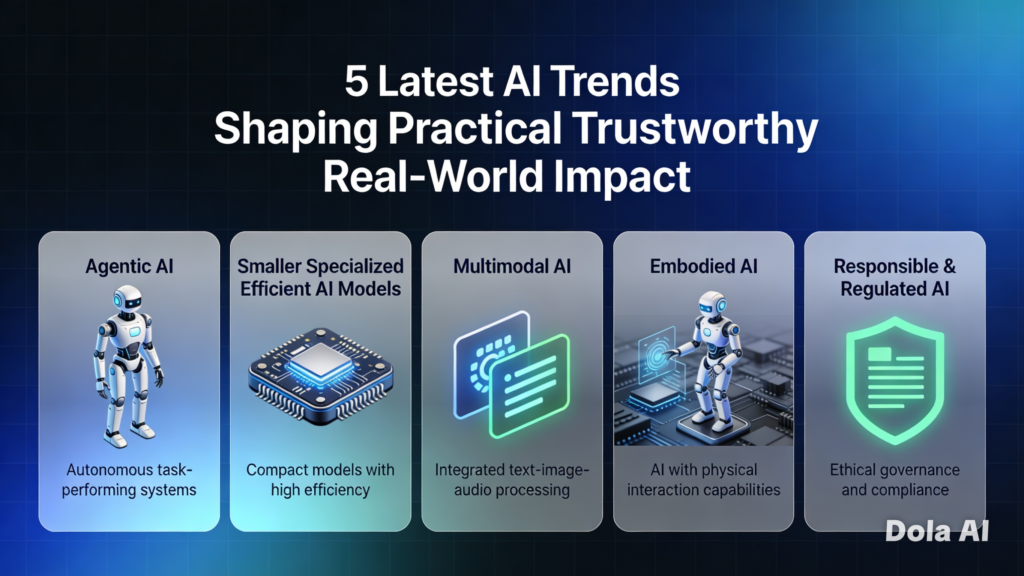
From experimental tools to core infrastructure, artificial intelligence is advancing faster than ever. In 2025–2026, the focus has shifted from raw capability to practicality, reliability, and real-world impact. Below are the five most transformative trends reshaping industries, research, and daily life.
1. Agentic AI: From Chatbots to Autonomous Workers
Traditional AI tools respond to commands, but agentic AI can independently plan, reason, and execute complex, multi‑step tasks. These systems connect to software, data sources, and workflows, making decisions and adjusting strategies when obstacles arise.
Key Developments
- Goal‑driven execution: Instead of just answering questions, agents can complete end‑to‑end work—such as booking travel, processing invoices, or managing supply chains.
- Tool use & integration: They can access databases, APIs, and other applications to gather information or take action.
- Memory & learning: New architectures let agents remember past interactions and improve performance over time.
Real‑World Impact
Companies are using agentic AI to automate workflows in finance, customer service, and operations, cutting manual work by 30–50% in some use cases. As these systems become more reliable, they will act as digital collaborators, not just tools.
2. Smaller, Specialized, and Efficient AI Models
For years, “bigger was better” was the rule—but now, smaller, task‑specific models are taking center stage. These compact systems deliver equal or better performance than large general‑purpose models while using far less computing power, energy, and cost.
Key Developments
- Domain‑specific fine‑tuning: Models are tailored for healthcare, law, manufacturing, or engineering, delivering higher accuracy and compliance.
- Edge AI: Models now run directly on devices like phones, sensors, and cameras, enabling real‑time processing and better data privacy without relying on cloud servers.
- Mixture‑of‑Experts (MoE): These architectures activate only the parts of the model needed for a given task, balancing capability and efficiency.
Real‑World Impact
Efficient models make AI accessible to smaller businesses and resource‑constrained environments. They also reduce the environmental footprint of AI, addressing growing concerns about energy use.
3. Multimodal AI: Understanding the World Like Humans
Multimodal AI can process, understand, and generate text, images, audio, video, and sensor data—just as humans use multiple senses to interpret information. The latest breakthroughs have improved cross‑modal understanding and generation quality dramatically.
Key Developments
- Unified understanding: New models analyze relationships across data types—for example, describing a video in detail, answering questions based on a combination of text and diagrams, or converting spoken language directly into 3D models.
- High‑quality generation: Real‑time video generation, photorealistic design, and synchronized speech‑to‑animation are now production‑ready.
- Scientific applications: Multimodal systems help researchers combine experimental data, research papers, and visualizations to accelerate discoveries in medicine, materials science, and climate research.
Real‑World Impact
This trend is revolutionizing education, media, and design, while also improving diagnostic accuracy in healthcare and enhancing safety systems in autonomous vehicles.
4. Embodied AI: Bringing Intelligence to the Physical World
Embodied AI connects intelligent systems to physical bodies—such as robots, drones, and smart devices—enabling them to perceive, interact with, and navigate the real world. The gap between simulation and real‑world performance has narrowed significantly.
Key Developments
- World models: AI systems build internal representations of physical environments, predicting outcomes of actions and adapting to changes.
- Humanoid robots: Advances in motion control and sensor processing are bringing versatile robots closer to practical use in manufacturing, logistics, and caregiving.
- Sensor fusion: Combining data from cameras, lidar, touch sensors, and microphones lets machines understand context and operate safely alongside humans.
Real‑World Impact
Embodied AI is transforming logistics, construction, and healthcare, creating systems that can perform tasks too dangerous, repetitive, or precise for humans.
5. Responsible & Regulated AI: Balancing Innovation with Trust
As AI becomes more powerful and widespread, governance, transparency, and safety are no longer optional—they are essential. Governments and industries are moving from guidelines to enforceable rules, while technology itself is evolving to be more trustworthy.
Key Developments
- Compliance‑by‑design: Systems are built from the ground up to meet regulations like the EU AI Act, US federal guidelines, and industry‑specific standards.
- Explainable AI (XAI): New methods make model decisions clear and verifiable, critical for high‑stakes use cases like healthcare diagnostics, legal decisions, and finance.
- Bias mitigation & fairness: Better testing and training techniques reduce discrimination and ensure equitable outcomes across different groups.
- Data privacy techniques: Approaches like federated learning and zero‑knowledge proofs enable AI to learn without exposing sensitive information.
Real‑World Impact
Organizations that build responsible AI will gain customer trust and avoid legal risks, while regulation will create a level playing field that ensures innovation benefits society broadly.
Conclusion
AI is moving beyond hype to deliver tangible, scalable value. The trends of agentic autonomy, efficient specialized models, multimodal understanding, physical embodiment, and responsible governance are defining this new era. Businesses and researchers that embrace these directions will not only stay competitive but also help shape a future where AI works safely and effectively for everyone.